Construction
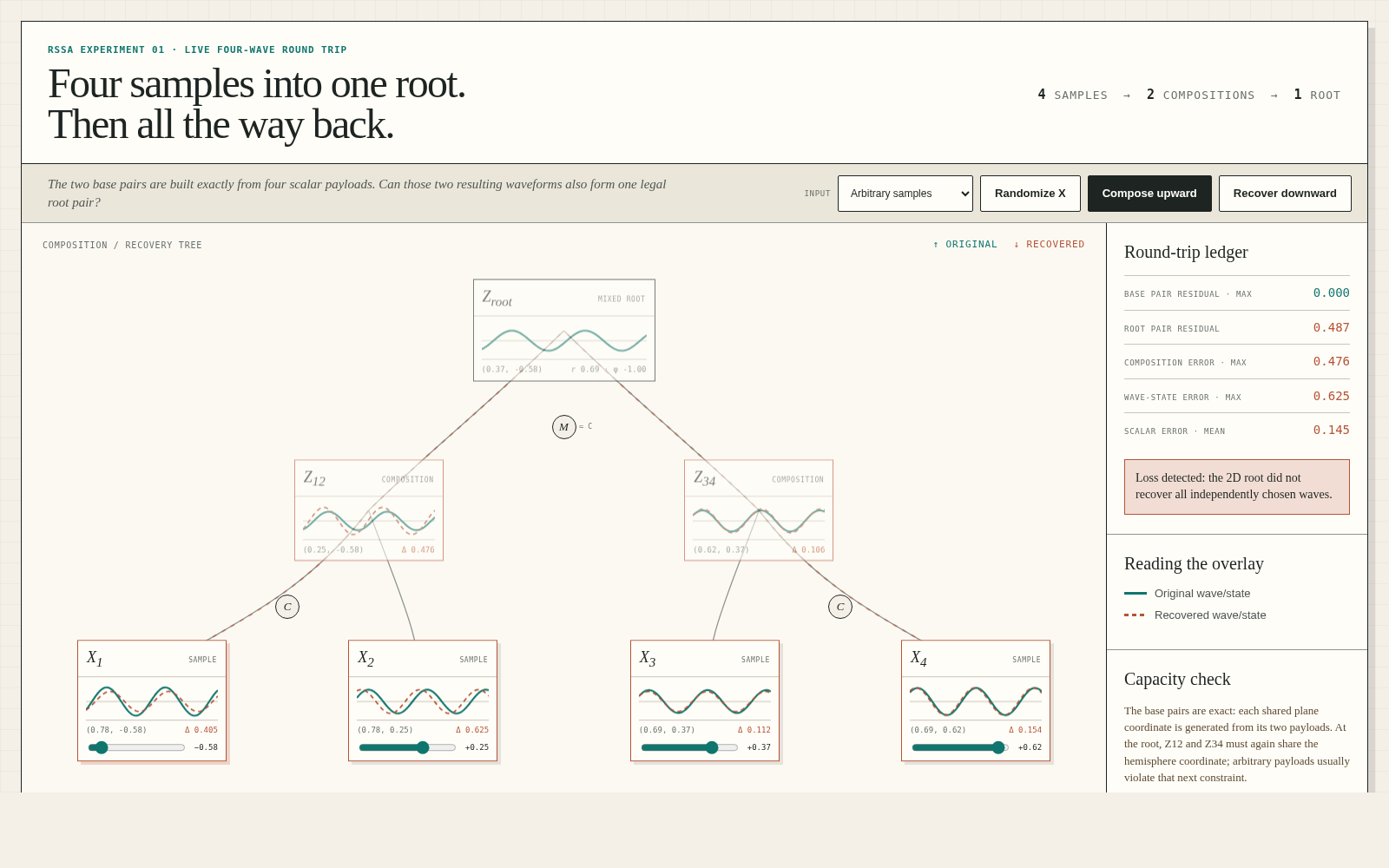
The current construction represents a state as a bounded two-dimensional phasor:
z = (A cos(φ), A sin(φ)), ‖z‖ < 1
Two invertible transformations, L and R, map a state to a pair of child states. They rotate the Poincaré disk around different interior pivots. Their order matters.
Composition maps both children back to parent coordinates and averages the estimates:
C(x, y) = ½ (L⁻¹(x) + R⁻¹(y))
For children constructed from the same parent, C(L(z), R(z)) = z, up to floating-point error.
What the construction implies
Either legal child determines its parent. The pair therefore contains redundancy: it lies on a two-dimensional manifold within a four-dimensional space.
For an arbitrary pair of children, averaging their inverse images discards their disagreement. The round trip for a legal pair is not a lossless encoding of arbitrary inputs.
Memory question
The next question is whether repeated applications of L and R give useful read views of a small state. Algebraic consistency alone does not answer that question.
A comparison needs to account for persistent state size and readout capacity. An ordinary state with several learned read views is a relevant control; otherwise, extra read-time computation could explain a difference.
Limits
The number of paths through the construction does not measure stored information. Distinct paths can produce related views of the same underlying state.
Sequence-memory comparisons still need a fixed precision, storage budget, and readout budget.
Related experiments
The same workspace contains several follow-up studies. They ask different memory questions and do not follow automatically from the construction above.
Exact-memory Mamba
This track studies external storage of exact content and bounded code localization. Immutable repository snapshots, retrieval, reranking, and limited file reads separate stored evidence from the model's choice of what to inspect. Reliable evidence selection across repositories remains unresolved.
WaveCapsule
The current direction is a queryable, replayable memory layer for Mamba-3. Earlier waveform and file-compression experiments remain part of its history. The work distinguishes using supplied memory from autonomously deciding when and where to retrieve it.
Recurrent Memory
This experiment combines Mamba-3 with independently trained diffusion blocks and predicted future residual states. Controlled sequence tasks examine whether the routed residual contributes information beyond matched alternatives.
Rotational state dynamics
A separate harness compares noncommuting, token-conditioned rotations with commuting rotations and ordinary recurrent updates. Its question concerns sequence representation, rather than exact storage. A useful result must survive matched controls and length-generalization checks before being transferred into a larger memory system.