SimAct studies whether a smaller, slower learning module can provide useful updates to a main model. Earlier experiments examine activation relationships; the current sequence experiment uses topic classification over complete news articles.
Sequence experiment
A causal encoder produces features as an article is read. A compressed recurrent module observes those features periodically and accumulates its own context. A graph connects a state only to eligible past states from the same article.
Training separates three updates: ordinary task learning in the main model, local learning in the compressed module on detached features, and a feedback step that returns the compressed module's feature gradient to the current main encoder.
The comparison includes extra task replay, a slow module without relationship edges, related-context feedback, and shuffled causal relationships. Evaluation uses the main classifier so that any benefit must transfer into it rather than come from an extra prediction head.
Recorded result
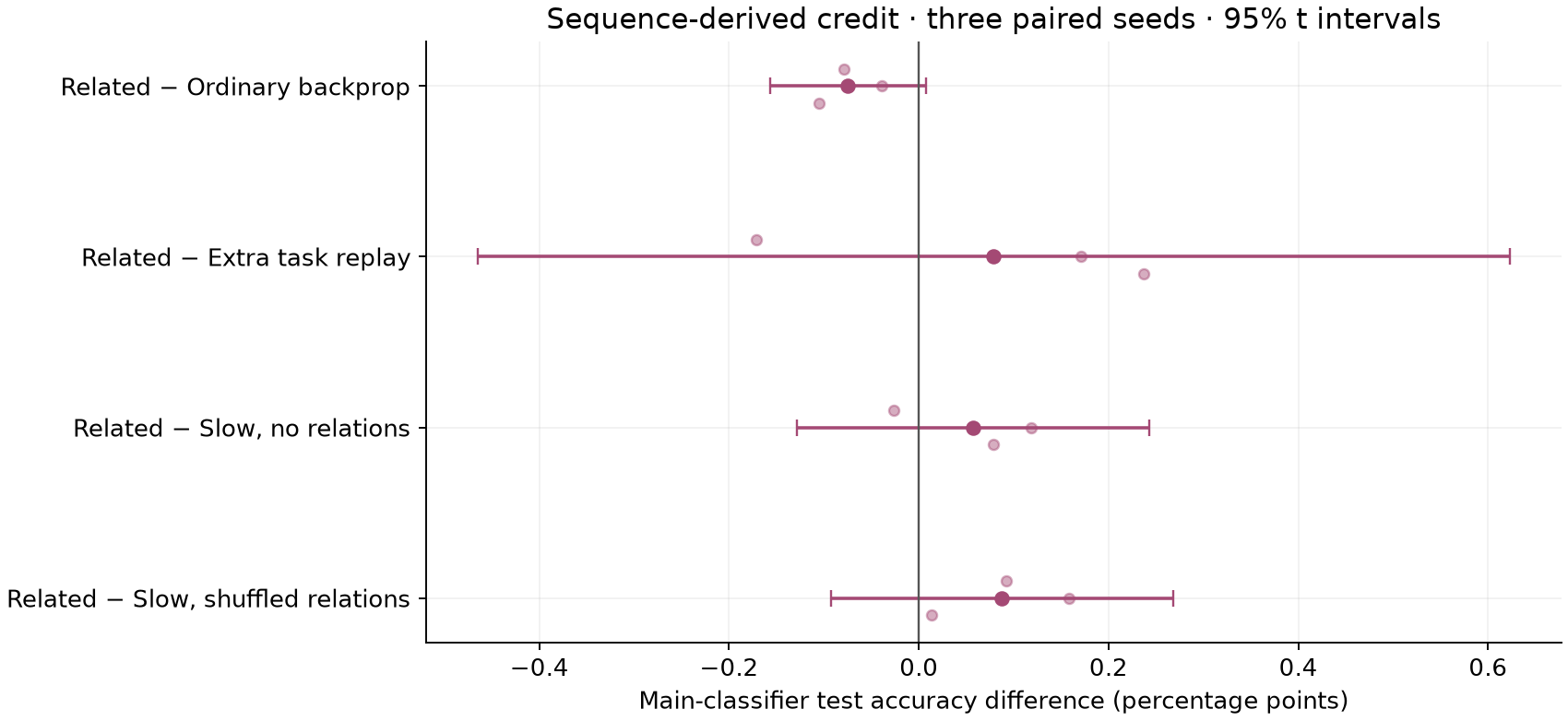
The completed comparison contains 15 runs: five methods across three matched seeds. Related-context feedback reached 91.39% mean main-classifier accuracy, compared with 91.33% for the slow module without relationships and 91.46% for ordinary backpropagation.
The primary related-minus-plain difference was +0.057 percentage points, with a paired 95% interval of −0.129 to +0.243. This does not establish an accuracy benefit. The intervals use three seeds and have no adjustment for multiple comparisons.
The feedback is an auxiliary-loss gradient conditional on a frozen graph. It is not evidence of causal attribution or guaranteed task-loss improvement, and short-article classification does not establish long-horizon reasoning.
Data
The experiment uses AG News, with a training-only vocabulary and a held-out validation split. Ten exact normalized training/test text overlaps are disclosed in the experiment record; excluding them does not change the ordering of methods.