This experiment represents an image as a graph of persistent node states. A shared update rule repeatedly exchanges information between connected nodes, adds a residual update, and leaves classification to a common readout.
Comparison
The central question is what local communication changes when the rest of the model stays comparable. Grid, nearest-neighbor, random, small-world, and complete graphs provide different communication patterns. A learned dense mixer supplies another baseline.
The complete-graph comparison is especially direct: it changes the communication graph without adding trainable parameters. Other sweeps vary update depth, shared versus step-specific rules, and residual scaling.
Training uses ordinary global backpropagation. Locality here describes message exchange, not an alternative credit-assignment algorithm.
Image classification, distant-patch tasks, and propagation diagnostics probe different consequences of the graph. A decoder-only language experiment extends the same line of inquiry, but any benefit needs to be assessed alongside parameter count, computation, and the number of recurrent updates.
Inference-length sweep
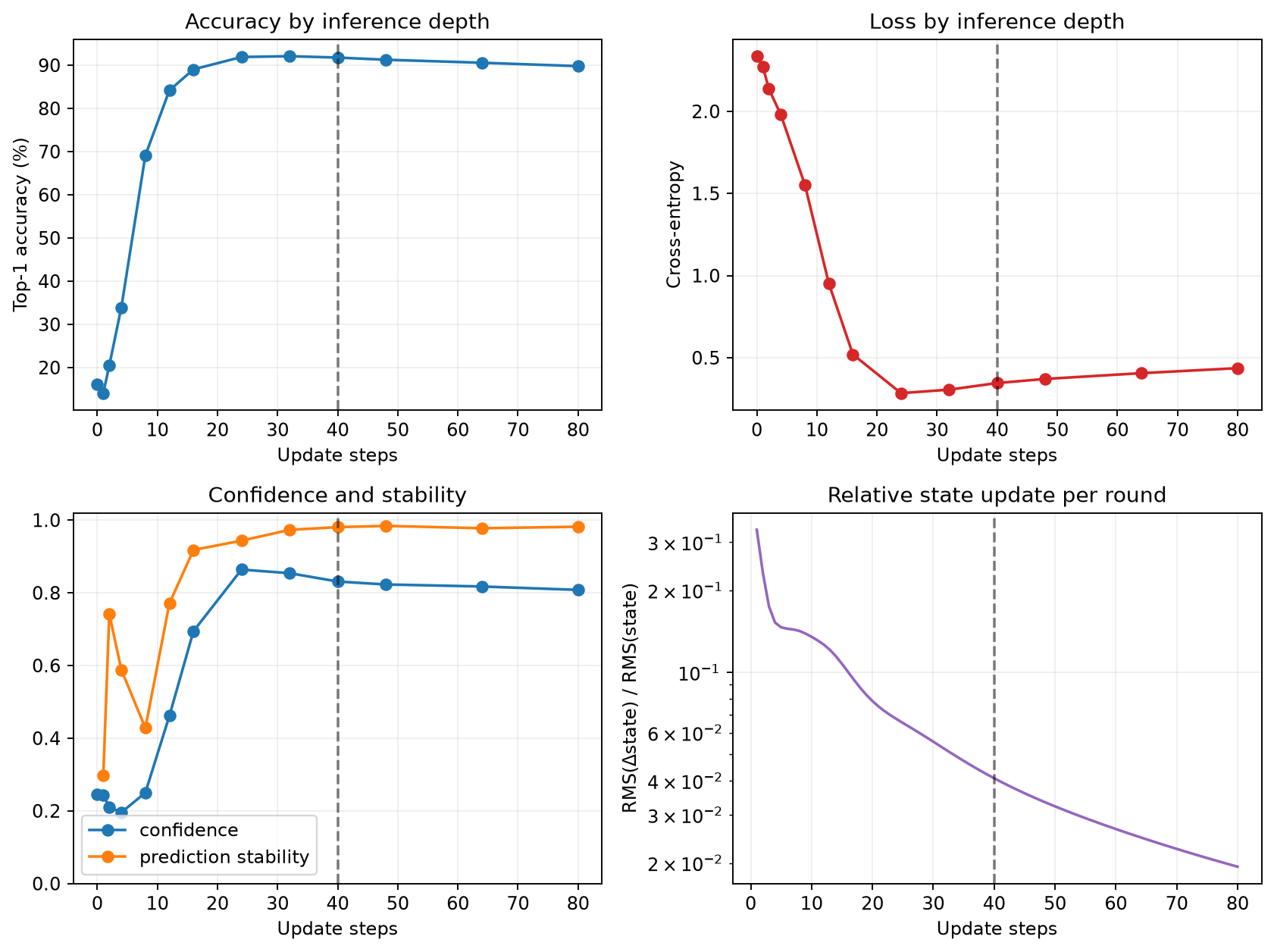
The figure shows one CIFAR-10 run trained with 40 recurrent steps, evaluated at several inference lengths. Accuracy peaks before 40 steps and declines at longer lengths in this run. It is a diagnostic from one seed, not an estimate across repeated training runs or evidence that more inference generally helps.